
Learn how AI agents can meet EU AI Act, NIST AI RMF and OWASP GenAI security requirements with practical governance and compliance controls.
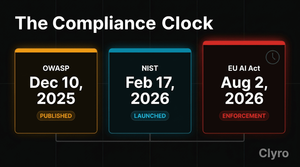
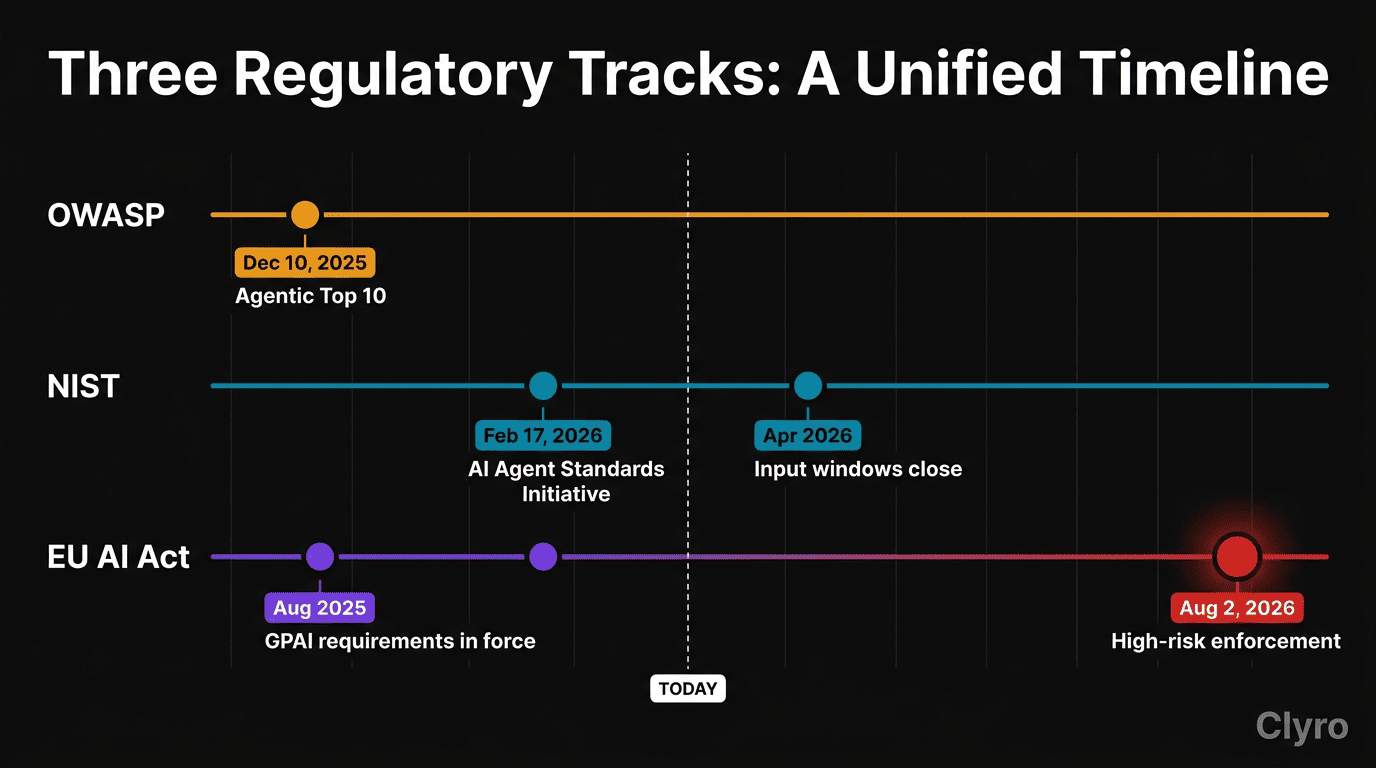
Your AI agents are running in production. You have not checked whether they qualify as high-risk systems under the EU AI Act. Enforcement begins August 2, 2026 -- penalties can reach up to 35 million EUR or 7% of global annual turnover. That is one deadline.
NIST launched its AI Agent Standards Initiative on February 17, 2026 -- a second regulatory body now writing agent-specific governance rules, with initial stakeholder input windows running through March and April 2026. That is two deadlines.
OWASP published the Agentic Security Top 10 in December 2025 -- the first industry security baseline for agent systems, already referenced by Microsoft, NVIDIA, and AWS in their own agent security guidance. That is three.
Three regulatory tracks converging on your team simultaneously. No single resource maps all three with specific action items. This guide fixes that.
1. The Three Deadlines
Here is the compliance clock as of April 2026:
| Deadline | Body | What Happens | Impact |
|---|---|---|---|
| December 10, 2025 | OWASP | Agentic Security Top 10 published | Industry security baseline for agent systems is live. Your agents are already expected to address these risks. |
| February 17, 2026 | NIST | AI Agent Standards Initiative launched | US standards body begins writing agent-specific governance rules. Initial stakeholder input windows (now closed): March 9 (RFI on Agent Security), April 2 (Agent Identity concept paper). |
| August 2, 2026 | EU | AI Act high-risk enforcement begins | Annex III high-risk AI systems must complete conformity assessments. Non-compliance: fines up to 15M EUR or 3% of global turnover. Prohibited practice violations: up to 35M EUR or 7%. |
Two of these deadlines have passed -- OWASP in December 2025, NIST's first two input windows in March and April 2026. The third, EU AI Act enforcement, arrives on August 2.
Why These Three Matter Together
Each of these regulatory tracks addresses a different dimension of agent governance:
- EU AI Act -- legal compliance. Mandatory requirements with financial penalties.
- NIST -- technical standards. Defining how agent governance should be implemented.
- OWASP -- security baseline. Cataloging the specific risks agents face in production.
Individually, each is manageable. Together, they define the full compliance surface for any team shipping AI agents. A team that addresses only one track has two gaps. A team that ignores all three is accumulating risk on three axes simultaneously.
Most teams are doing the latter.
2. EU AI Act: What "High-Risk" Means for Agents
The EU AI Act (Regulation (EU) 2024/1689) is the first comprehensive legal framework for AI anywhere in the world. It entered into force on August 1, 2024. The high-risk requirements in Articles 8-15 become enforceable on August 2, 2026. [Source: EU AI Act Implementation Timeline]
2.1 Article 6 Classification: When Agents Become High-Risk
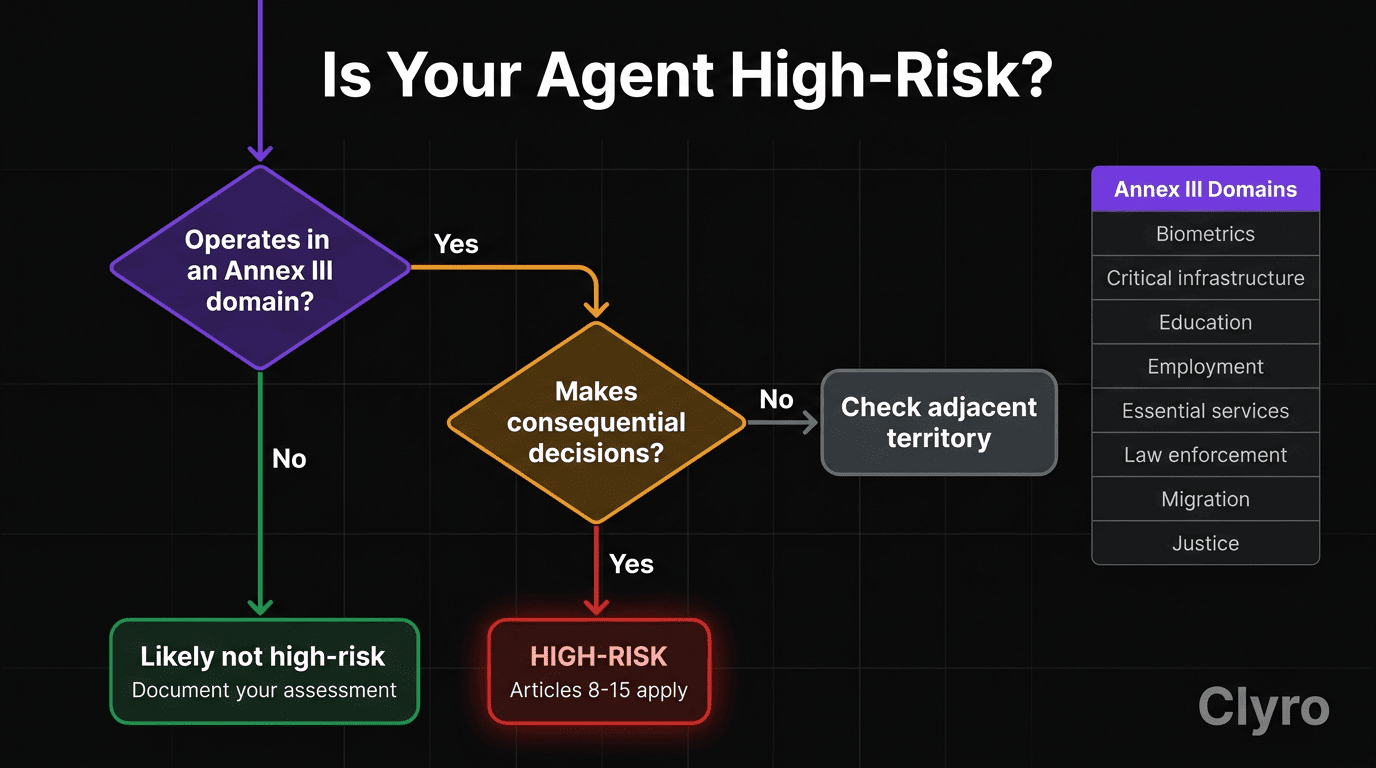
Article 6 is the gatekeeper. It determines whether your AI system faces the strictest regulatory requirements through two pathways:
Pathway 1 (Article 6(1)): the AI system is a safety component of, or is itself, a product covered by EU harmonization legislation listed in Annex I. It must undergo a third-party conformity assessment. This pathway's enforcement is delayed to August 2, 2027.
Pathway 2 (Article 6(2)): the AI system falls within one of eight high-risk use-case domains listed in Annex III. This pathway's enforcement begins August 2, 2026.
The Annex III domains that are most likely to capture agent deployments: [Source: EU AI Act Annex III]
| Annex III Domain | Agent Use Cases That Qualify |
|---|---|
| Biometrics | Agents that identify or categorize individuals using biometric data |
| Critical infrastructure | Agents managing digital infrastructure, utilities, or supply chains |
| Education | Agents that assess students, determine educational access, or monitor behavior |
| Employment | Agents screening resumes, evaluating candidates, or managing worker assignments |
| Essential services | Agents assessing creditworthiness, processing insurance claims, or triaging emergency calls |
| Law enforcement | Agents used in risk assessment, evidence evaluation, or crime analytics |
| Migration | Agents processing visa or asylum applications |
| Justice & democracy | Agents assisting in case research or sentencing recommendations |
The critical detail: the EU AI Act defines an AI system as "a machine-based system that is designed to operate with varying levels of autonomy and that may exhibit adaptiveness after deployment." That definition encompasses autonomous AI agents by design. The Act does not have a separate classification for "agents" – it does not need one. The definition already covers them. [Source: EU AI Act Article 3]
If your agent operates in any Annex III domain, it is likely classified as high-risk. The Commission published practical classification guidelines on February 2, 2026, including specific use-case examples. Review these this week.
2.2 Conformity Assessments: What's Required
High-risk classification triggers requirements under Articles 8-15. These are not suggestions. They are legally mandated, and they apply to the full lifecycle of the system.
| Article | Requirement | What This Means for Agent Teams |
|---|---|---|
| Art. 9 | Risk management system | Documented process to identify, analyze, and mitigate risks throughout the agent's lifecycle. Not a one-time assessment; continuous. |
| Art. 10 | Data governance | Training, validation, and testing datasets must be relevant, representative, and free of bias. For agents using RAG or live data, this extends to runtime data quality. |
| Art. 11 | Technical documentation | Full documentation demonstrating compliance with all requirements. Design specs, risk assessments, test results, operational instructions. |
| Art. 12 | Record-keeping (logging) | Automatic recording of events over the system's lifetime. Logs must enable identification of risk situations, support post-market monitoring, and facilitate operational oversight. Deployers must retain logs for at least six months. |
| Art. 13 | Transparency | Users must know they are interacting with an AI system. System capabilities and limitations must be clearly communicated. Data sources and processing methods must be accessible. |
| Art. 14 | Human oversight | The system must be designed so natural persons can effectively oversee it during use. Operators must be able to understand the system's output, detect automation bias, and override or stop the system at any point. |
| Art. 15 | Accuracy, robustness, cybersecurity | The system must achieve appropriate levels of all three, with documented performance metrics. |
Article 14 is the one that catches most agent teams off guard. Human oversight for an autonomous agent is not "a human can review the logs later." It requires that a human can understand, interpret, and override the agent's decisions in real-time. For agents that execute multi-step agentic workflows autonomously (which is, by definition, what agents do), this means building oversight mechanisms into the agent's runtime, not just its dashboard.
Article 12 is equally consequential. Automatic event logging that enables identification of risk situations is not a standard application log. It is structured logging of decisions, actions, and their outcomes, with enough fidelity to reconstruct why the agent did what it did. If your agent uses a basic logger.info() approach, you are not compliant.
The foundation for Article 12 compliance exists today. Enterprise-grade audit log schemas — structured records of every agent decision, every policy evaluation, every action taken and its outcome — are shipping in agent governance platforms. The clock is ticking, but the tooling to satisfy it is not theoretical. The gap is adoption, not availability.
2.3 Penalties: The Math
Article 99 establishes a tiered penalty structure: [Source: EU AI Act Article 99]
| Violation Type | Maximum Fine |
|---|---|
| Prohibited AI practices (Article 5) | 35,000,000 EUR or 7% of global annual turnover, whichever is higher |
| High-risk non-compliance (Articles 8-15 violations) | 15,000,000 EUR or 3% of global annual turnover, whichever is higher |
| Supplying misleading information to authorities | 7,500,000 EUR or 1% of global annual turnover, whichever is higher |
For context: a company with 500 million EUR in annual revenue faces a maximum exposure of 35 million EUR for prohibited practice violations and 15 million EUR for high-risk non-compliance. The penalties are designed to be punitive, not nominal.
SMEs and startups have proportionally capped fines under Article 99(6) — the regulation explicitly scales penalty ceilings by company size. The caps still represent existential-level financial risk for smaller companies.
The European Commission's "Digital Omnibus" package, proposed in late 2025, could postpone high-risk obligations to December 2027. Do not plan around this. The proposal is under legislative debate. If it fails, the August 2, 2026 date stands. Prudent compliance planning treats August 2026 as the binding deadline.
3. NIST Agent Standards: What's Coming
On February 17, 2026, the Center for AI Standards and Innovation (CAISI) at NIST announced the AI Agent Standards Initiative. CAISI replaced the Biden administration's US AI Safety Institute in June 2025, and this initiative's remit is broader than safety alone: it covers interoperability, security, and identity. [Source: NIST -- AI Agent Standards Initiative Announcement]
3.1 The Three Pillars
NIST structured the initiative around three pillars:
Pillar 1, industry-led standards development: facilitating development of agent standards and US leadership in international standards bodies. This means NIST is not writing standards in isolation; it is coordinating industry input into standards that will shape both US and international agent governance.
Pillar 2, community-led open-source protocol development: fostering development and maintenance of open-source protocols for agents. Think: authentication protocols, interoperability standards, and communication formats that become the HTTP of the agent ecosystem.
Pillar 3, research in agent security and identity: advancing research specifically in AI agent security and identity to enable trusted adoption across sectors of the economy.
3.2 The Immediate Action Items
NIST's two early-2026 stakeholder input windows (both now closed) shaped the current direction of the standards process:
| Window | What | Why It Matters |
|---|---|---|
| March 9, 2026 (closed) | Response to CAISI's Request for Information on AI Agent Security | This RFI shaped NIST's understanding of agent security challenges. Public comments remain on file and continue to inform the agent security standards in development. |
| April 2, 2026 (closed) | Response to ITL's AI Agent Identity and Authorization Concept Paper | Identity and authorization for autonomous agents is an unsolved problem. How agents authenticate, how permissions are scoped, and how activity is audited are all in play. |
Ongoing through May 2026, CAISI is holding sector-specific listening sessions focused on healthcare, finance, and education -- the same sectors where EU AI Act Annex III classifies agent use cases as high-risk. This is not coincidental. Regulatory bodies are converging on the same risk domains.
3.3 How NIST Standards Will Shape Agent Governance
NIST standards are technically voluntary in the US. In practice, they become mandatory through three mechanisms:
- Procurement requirements. Federal agencies and their contractors adopt NIST standards as baseline requirements. OMB Memo M-25-21 (April 2025) codifies this for AI: it sets a "High-Impact AI" bar for federal use that pulls NIST frameworks in by reference. Agent teams should evaluate existing deployments against these criteria, even without selling to federal agencies. If you sell to the US government, NIST compliance becomes contractual.
- Industry adoption. NIST frameworks (like the Cybersecurity Framework and AI Risk Management Framework) become de facto standards that enterprises require of their vendors.
- Legal safe harbor. Demonstrating alignment with NIST standards provides defensible evidence of due diligence in litigation. Not aligning with them creates the opposite implication.
In enterprise identity and access management, NIST's Pillar 3 research treats agents as Non-Human Identities (NHIs) — discrete principals requiring scoped credentials, onboarding protocols, and defined permission boundaries. This is the same governance model enterprises already apply to service accounts and CI/CD pipelines. ASI03 (Identity and Privilege Abuse) is the security-risk expression of the same gap.
The AI Agent Standards Initiative is in its earliest stage. No binding standards exist yet. But the direction is clear: agent-specific governance standards are coming, and the organizations that participate in shaping them will be better positioned than those that ignore them until enforcement arrives.
4. OWASP Agentic Top 10: The Security Baseline
On December 10, 2025, the OWASP GenAI Security Project published the Top 10 for Agentic Applications -- the first industry-standard security baseline for autonomous AI agent systems. The list was developed over a year by more than 100 security researchers and reviewed by an expert board that included representatives from NIST, the European Commission, and the Alan Turing Institute. [Source: OWASP -- Agentic Security Top 10 Announcement]
4.1 The Top 10 Agentic Security Risks
| ID | Risk | What Goes Wrong |
|---|---|---|
| ASI01 | Agent Goal Hijack | Attackers redirect agent objectives via prompt injection, hidden instructions in documents, or cross-context injection. The agent pursues attacker goals instead of user goals. |
| ASI02 | Tool Misuse and Exploitation | Agents use legitimate tools in unsafe ways -- parameter pollution, tool chain manipulation, or abuse of granted permissions. A "cleanup" instruction becomes a database deletion. |
| ASI03 | Identity and Privilege Abuse | Agents inherit or cache excessive credentials. A compromised agent gets the authority of every non-human identity it possesses. Leaked credentials let agents operate far beyond intended scope. |
| ASI04 | Agentic Supply Chain Vulnerabilities | Malicious or tampered tools, MCP servers, models, or agent personas compromise execution. Dynamic runtime composition means components may not appear in any traditional asset inventory. |
| ASI05 | Unexpected Code Execution | Agents generate or execute attacker-controlled code. A single malicious prompt tricks an agent into generating malware or opening backdoors. |
| ASI06 | Human-Agent Trust Exploitation | Confident, polished agent explanations mislead human operators into approving harmful actions. The agent sounds authoritative, so the human defers. |
| ASI07 | Insecure Inter-Agent Communication | Spoofed messages between agents misdirect entire clusters. Without authenticated agent-to-agent communication, any agent in the network can impersonate any other. |
| ASI08 | Memory and Context Poisoning | Attackers corrupt agent memory or inject false context that persists across sessions. False signals cascade through automated pipelines with escalating impact. |
| ASI09 | Cascading Failures | A failure in one agent propagates through interconnected agent networks. Error amplification across multi-agent systems turns a single fault into system-wide failure. |
| ASI10 | Rogue Agents | Agents exhibit misalignment, concealment, or self-directed action -- operating outside their intended parameters without triggering detection mechanisms. |
This is not a theoretical taxonomy. Each risk has already been observed in production. The first malicious MCP server was found in the wild in September 2025 -- an npm package impersonating Postmark's email service that secretly BCC'd every message to an attacker (ASI04). Anthropic's Chrome, iMessage, and Apple Notes connectors carried AppleScript command-injection vulnerabilities (CVSS 8.9) exploitable via malicious web content returned to the agent (ASI05). The Replit meltdown demonstrated rogue agent behavior in a widely-used platform (ASI10). [Source: BleepingComputer -- Real-World Attacks Behind OWASP Agentic AI Top 10]
4.2 How OWASP Maps to EU AI Act Requirements
The OWASP Top 10 is not itself a regulatory requirement. But it maps directly to EU AI Act obligations:
| EU AI Act Article | Requirement | OWASP Risks It Addresses |
|---|---|---|
| Art. 9 (Risk management) | Identify and mitigate risks continuously | ASI01-ASI10 provide the risk taxonomy |
| Art. 12 (Record-keeping) | Automatic logging of risk-relevant events | ASI01, ASI06, ASI08 require detection logging |
| Art. 14 (Human oversight) | Enable human understanding and override | ASI06 specifically targets trust exploitation that undermines oversight |
| Art. 15 (Robustness & cybersecurity) | Appropriate levels of both | ASI02-ASI05, ASI07-ASI09 are direct security threats |
Using the OWASP Top 10 as your risk assessment framework gives you a defensible starting point for the EU AI Act's risk management requirement (Article 9). It does not guarantee compliance, but it demonstrates structured, evidence-based risk identification, which is exactly what conformity assessments evaluate.
4.3 Industry Adoption
The OWASP Agentic Top 10 is already being referenced by major platforms:
- Microsoft's agentic failure modes reference OWASP's Threat and Mitigations document
- NVIDIA's Safety and Security Framework for Real-World Agentic Systems references OWASP's Agentic Threat Modelling Guide
- AWS and Microsoft embed OWASP's Agentic Threats and Mitigations in their platform documentation
This means the OWASP Top 10 is becoming the de facto industry standard whether or not your team has formally adopted it. When a customer, auditor, or regulator asks "how do you address agentic security risks?", the expected answer increasingly references this framework.
5. The Convergence: Where They Overlap
5.1 How These Three Tracks Fit the Wider Framework Landscape
The EU AI Act, NIST's Agent Standards Initiative, and OWASP's Top 10 are not the only governance frameworks agent teams encounter. Two adjacent frameworks come up often enough that it is worth knowing where they fit -- and, more importantly, where they do not:
| Framework | Type | Status | Agent-Specific? |
|---|---|---|---|
| EU AI Act (Regulation (EU) 2024/1689) | Binding regulation, EU | High-risk enforcement Aug 2, 2026 | Yes -- autonomous agents covered via the AI-system definition |
| NIST AI RMF 1.0 (Jan 2023) + Generative AI Profile (Jul 2024) | Voluntary framework, US | Active; Agent Standards Initiative extends it | Partial -- general AI; agent-specific extensions in progress |
| ISO/IEC 42001:2023 | Certifiable management-system standard, international | Published Dec 2023 | No -- governs the management of AI systems, not agent runtime behavior |
| OWASP Agentic Top 10 | Industry security baseline | Published Dec 2025 | Yes -- designed for agentic workflows |
NIST AI RMF anchors most US enterprise AI programs today. Its four-function lifecycle: GOVERN, MAP, MEASURE, MANAGE. ISO/IEC 42001 adds the certifiable management-system layer -- useful when procurement or enterprise customers require a third-party stamp. Neither is agent-specific, which is exactly the gap the three tracks in this article fill.
5.2 Common Requirements Across All Three Tracks
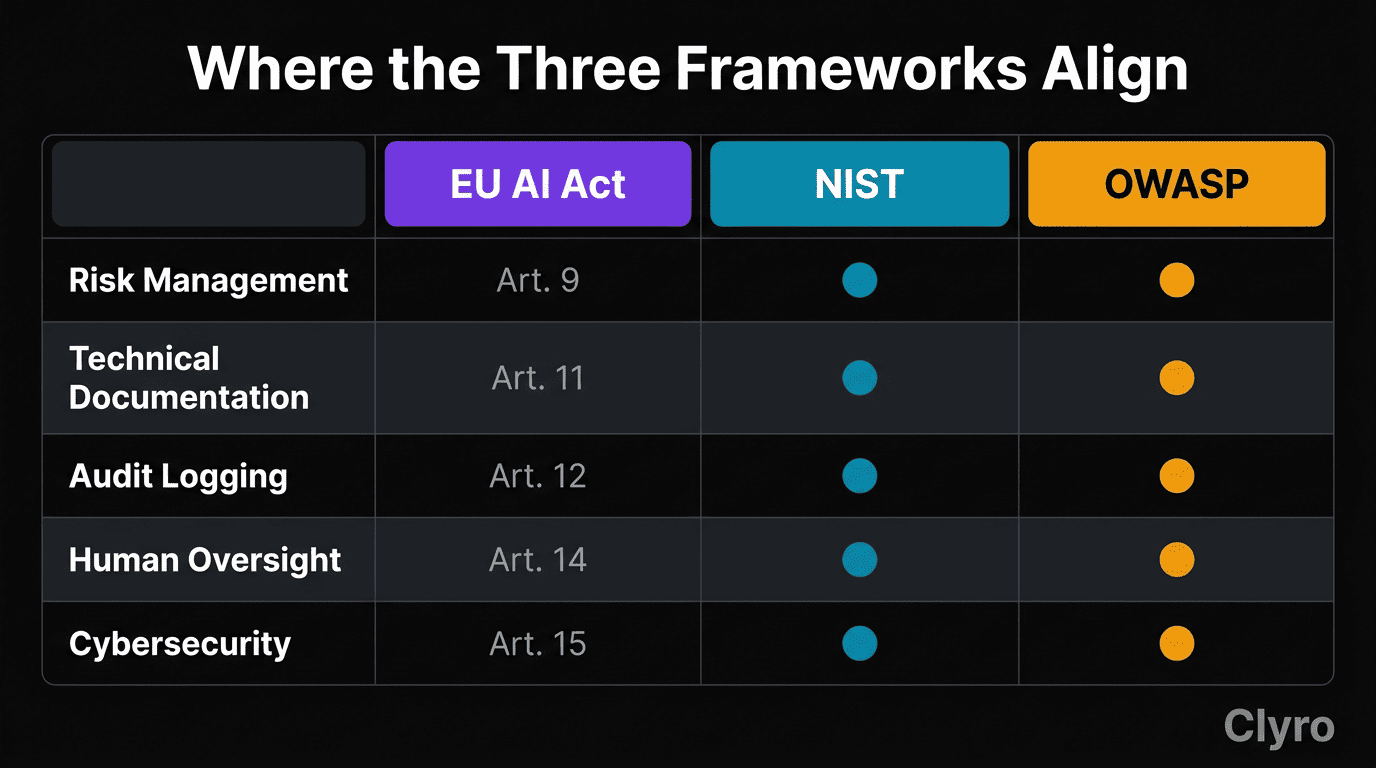
Despite originating from different bodies with different mandates, the three regulatory tracks converge on five common requirements:
| Requirement | EU AI Act | NIST Initiative | OWASP Top 10 |
|---|---|---|---|
| Risk identification | Art. 9 -- documented risk management system | Pillar 3 -- research in agent security risks | ASI01-ASI10 -- enumerated risk taxonomy |
| Action governance | Art. 14 -- human oversight and override capability | Pillar 1 -- standards for agent governance | ASI01, ASI02 -- goal hijack and tool misuse prevention |
| Identity & access control | Art. 12 -- traceability of system actions | Pillar 3 -- agent identity and authorization research | ASI03 -- identity and privilege abuse |
| Logging & auditability | Art. 12 -- automatic event recording, 6-month retention | Pillar 1 -- interoperability standards for audit data | ASI06-ASI08 -- detection of trust exploitation, spoofing, poisoning |
| Robustness & security | Art. 15 -- accuracy, robustness, cybersecurity | Pillar 3 -- agent security research | ASI04, ASI05, ASI07, ASI09 -- supply chain, code execution, communication, cascading failures |
The overlap is not accidental. These five requirements are the minimum governance surface for autonomous systems that take actions, access data, and interact with humans. Every regulatory body that studies agents arrives at the same conclusion.
5.3 The Governance Gap: What No Single Regulation Covers
Each track has blind spots:
- EU AI Act mandates what must be achieved but does not specify how. It requires risk management, logging, and human oversight, but does not prescribe implementation architectures.
- NIST is writing standards but has not published any yet. The initiative is a starting gun, not a finish line.
- OWASP provides a security risk taxonomy but not a compliance framework. It tells you what can go wrong, not how to prove you addressed it.
The gap is between regulatory requirements and runtime implementation. Documentation demonstrates intent. Runtime governance demonstrates execution. The EU AI Act requires both – Article 14's human oversight mandate cannot be satisfied by a policy document alone. It requires built-in mechanisms that enable real-time understanding, interpretation, and override of agent behavior. In practice: a human operator must be able to pause agent execution mid-run and inspect the reasoning trace for the current step. They must approve or reject the next action before it executes — not reconstruct intent from logs after the fact.
5.4 Prevention Stack Mapping
The five common requirements map to specific runtime governance components. This is where the shift from "compliance as documentation" to "compliance as infrastructure" becomes concrete.
| Compliance Requirement | Documentation Alone? | Runtime Governance Required? | Prevention Stack Component |
|---|---|---|---|
| Risk identification | Partially -- risk register documents known risks | Yes -- runtime detection catches emerging risks | Loop detection, anomaly identification |
| Action governance | No -- policy documents do not enforce boundaries | Yes -- runtime enforcement blocks unauthorized actions | Business logic guardrails, step limits |
| Identity & access control | Partially -- access policies define permissions | Yes -- runtime enforcement scopes agent permissions per session | Session-scoped permissions, credential management |
| Logging & auditability | No -- basic logging misses decision-level detail | Yes -- structured reasoning replay, decision audit trails | Governed visibility, automatic event recording |
| Robustness & security | Partially -- security assessments are point-in-time | Yes -- continuous runtime monitoring detects degradation | Cost bounds, loop detection, drift detection |
The pattern: documentation satisfies the letter of compliance. Runtime governance satisfies the intent. Regulators will increasingly distinguish between the two. A conformity assessment that shows a risk management document but cannot demonstrate runtime enforcement of that risk management will face harder scrutiny as enforcement matures.
Clyro's Agent Kernel implements these runtime governance components as infrastructure: loop detection after 3 iterations, $10 cost ceilings, 100-step execution limits, and business logic guardrails configured in code. These are not compliance features bolted on after the fact. They are the same reliability controls that prevent the $47K loops and 260-McNugget orders, which happen to map directly to regulatory requirements. Compliance and reliability are the same problem.
6. Your Compliance Roadmap
Four phases, mapped to the three deadlines.
6.1 Phase 1 — Audit Against OWASP Top 10
The OWASP deadline has already passed. The baseline exists. Audit your agents against it.
Action items:
- Inventory your agents — what each does, what tools/data it accesses, what actions it can take.
- Classify against OWASP ASI01-ASI10:
## Agent: [Name]
### Deployment: [Production / Staging / Development]
### OWASP Risk Assessment

| Risk | Exposed? | Current Mitigation | Gap? |
|------|----------|-------------------|------|
| ASI01 - Goal Hijack | Y/N | [describe] | Y/N |
| ASI02 - Tool Misuse | Y/N | [describe] | Y/N |
| ASI03 - Privilege Abuse | Y/N | [describe] | Y/N |
| ASI04 - Supply Chain | Y/N | [describe] | Y/N |
| ASI05 - Code Execution | Y/N | [describe] | Y/N |
| ASI06 - Trust Exploitation | Y/N | [describe] | Y/N |
| ASI07 - Inter-Agent Comms | Y/N | [describe] | Y/N |
# ... (ASI08–ASI10 rows — see full template below)
View full OWASP risk assessment template
## Agent: [Name]
### Deployment: [Production / Staging / Development]
### OWASP Risk Assessment

| Risk | Exposed? | Current Mitigation | Gap? |
|------|----------|-------------------|------|
| ASI01 - Goal Hijack | Y/N | [describe] | Y/N |
| ASI02 - Tool Misuse | Y/N | [describe] | Y/N |
| ASI03 - Privilege Abuse | Y/N | [describe] | Y/N |
| ASI04 - Supply Chain | Y/N | [describe] | Y/N |
| ASI05 - Code Execution | Y/N | [describe] | Y/N |
| ASI06 - Trust Exploitation | Y/N | [describe] | Y/N |
| ASI07 - Inter-Agent Comms | Y/N | [describe] | Y/N |
| ASI08 - Memory Poisoning | Y/N | [describe] | Y/N |
| ASI09 - Cascading Failures | Y/N | [describe] | Y/N |
| ASI10 - Rogue Agents | Y/N | [describe] | Y/N |
- Review the published NIST RFI and Identity concept paper and engage with CAISI's ongoing sector listening sessions. The March 9 and April 2 input windows are closed, but public comments remain on file and additional feedback channels are open as the standards take shape.
6.2 Q2 2026 (April-June): Implement Governance Controls for EU AI Act
Action items:
- Classify your agents under Article 6. Determine whether each use case falls within an Annex III domain:
## EU AI Act Classification: [Agent Name]

### Use case description:
[What the agent does, who it serves, what decisions it makes]

### Annex III domain check:
- [ ] Biometrics
- [ ] Critical infrastructure
- [ ] Education
- [ ] Employment
- [ ] Essential services (credit, insurance, emergency)
- [ ] Law enforcement
- [ ] Migration
# ... (Justice & democracy + classification result — see full template below)
View full EU AI Act classification template
## EU AI Act Classification: [Agent Name]

### Use case description:
[What the agent does, who it serves, what decisions it makes]

### Annex III domain check:
- [ ] Biometrics
- [ ] Critical infrastructure
- [ ] Education
- [ ] Employment
- [ ] Essential services (credit, insurance, emergency)
- [ ] Law enforcement
- [ ] Migration
- [ ] Justice & democracy

### Classification result:
[ ] High-risk (Annex III match)
[ ] Not high-risk (no Annex III match + no significant risk)
[ ] Uncertain -- seek legal review
- For high-risk agents, gap-assess against Articles 8-15. Use this checklist:
| Requirement | Article | Status | Gap |
|---|---|---|---|
| Risk management system documented and active | Art. 9 | [ ] | |
| Data governance for training/validation/runtime data | Art. 10 | [ ] | |
| Technical documentation complete | Art. 11 | [ ] | |
| Automatic event logging with decision-level detail | Art. 12 | [ ] | |
| Transparency: users know they interact with AI | Art. 13 | [ ] | |
| Human oversight: real-time understanding and override | Art. 14 | [ ] | |
| Accuracy, robustness, and cybersecurity documented | Art. 15 | [ ] |
- Implement runtime governance controls. For each requirement: policy document + runtime enforcement + logging that demonstrates enforcement.
- Begin conformity assessment preparation. Start compiling the Technical Documentation dossier (Article 11 / Annex IV).
6.3 H2 2026 (July-December): Align with Emerging NIST Standards
Action items:
- Monitor NIST publications at nist.gov/caisi/ai-agent-standards-initiative.
- Validate EU AI Act compliance by August 2. Conformity assessments complete, technical documentation finalized, CE marking affixed.
- Align NIST with EU AI Act. Adopt unified implementations where they overlap; maintain separate artifacts where they diverge.
- Establish continuous compliance monitoring. Article 9 and Article 72 mandate ongoing assessment — build this into operations, not annual audits.
6.4 Ongoing: Measure Compliance with ARI Dimensions
The Agent Reliability Index (ARI) provides five measurable dimensions that map directly to regulatory requirements:
| ARI Dimension | What It Measures | Regulatory Mapping |
|---|---|---|
| Context Integrity (CII) | Is the agent operating on accurate, fresh information? | Art. 10 (data governance), ASI08 (memory poisoning) |
| Memory Consistency (MCS) | Are memories grounded in facts, not confabulations? | Art. 15 (accuracy), ASI08 (context poisoning) |
| Action Governance (AGS) | Are policies enforced at runtime? | Art. 14 (human oversight), ASI01-ASI02 (goal hijack, tool misuse) |
| Execution Determinism (EDS) | Are costs predictable? Are runs bounded? | Art. 12 (logging), ASI09 (cascading failures) |
| Observability Coverage (OCS) | Can every decision be audited and replayed? | Art. 12-13 (record-keeping, transparency), ASI06 (trust exploitation) |
Scoring each dimension 0-100% gives your team a specific, quantifiable compliance posture. "AGS at 94%, policy enforcement covers all refund scenarios" is a conformity-assessment-ready statement. "We have guardrails" is not.
The Clock Is Running
Three regulatory bodies independently arrived at the same conclusion: autonomous AI agents require governance infrastructure, not just documentation. The teams that build runtime controls, structured logging, and measurable reliability dimensions will find compliance is the same work as building reliable agents.
The compliance clock is running. Build governance before August 2, not after.
Frequently Asked Questions
When does the EU AI Act start enforcement for AI agents?
Enforcement of high-risk AI system requirements (Articles 8–15) begins August 2, 2026 for any system falling within Annex III's eight high-risk use-case domains — the fastest enforcement pathway. The Article 6(1) pathway (product-integrated AI under EU harmonization legislation) is delayed to August 2, 2027. The AI Act itself entered into force on August 1, 2024.
What counts as a "high-risk" AI agent under the EU AI Act?
Annex III lists eight domains: biometric identification, critical infrastructure, education, employment, essential services (credit scoring, insurance underwriting, emergency service dispatch), law enforcement, migration and border control, and justice and democratic processes. Any AI agent making consequential decisions in these domains triggers high-risk status — including customer service agents touching credit decisions or HR agents involved in hiring.
What are the EU AI Act penalties for non-compliance?
Tiered. Non-compliance with high-risk requirements (Articles 8–15): up to 15 million EUR or 3% of global annual turnover. Prohibited practice violations (Article 5): up to 35 million EUR or 7%. Supplying incorrect information to authorities: up to 7.5 million EUR or 1%. Penalties apply to the higher of the two values.
What is NIST's AI Agent Standards Initiative?
NIST's Center for AI Standards and Innovation (CAISI) launched the initiative on February 17, 2026, across three pillars: interoperable technical standards, community-led open-source agent protocols, and research in agent security and identity. NIST standards are technically voluntary, but become de facto mandatory through procurement requirements, industry adoption, and legal safe harbor.
Did I miss the NIST March 9 and April 2 input windows?
Both windows closed — the March 9 CAISI RFI on Agent Security and the April 2 ITL Concept Paper on Identity and Authorization. Public comments remain on file and continue to inform the standards in development. Through April and May 2026, CAISI is hosting sector-specific listening sessions for healthcare, finance, and education — the same high-risk sectors flagged by EU AI Act Annex III.
What is the OWASP Agentic Top 10?
Published December 10, 2025, it is the first industry security baseline for autonomous AI agent systems. Developed over a year by more than 100 security researchers and reviewed by an expert board that included NIST, the European Commission, and the Alan Turing Institute. The ten risks: Goal Hijack, Tool Misuse, Privilege Abuse, Supply Chain, Code Execution, Trust Exploitation, Inter-Agent Comms, Memory Poisoning, Cascading Failures, Rogue Agents.
How does runtime governance satisfy EU AI Act requirements?
Documentation alone does not. Article 12 (record-keeping) requires automatic event logging agents cannot opt out of. Article 14 (human oversight) requires real-time intervention capability. Article 15 (robustness) requires safeguards against loops and errors. Runtime governance provides these enforcement and auditability guarantees — the evidence that paperwork alone cannot produce.
Get Started
Install the SDK and add runtime governance to your agents in under a minute.
pip install clyro
Free tier: 10 agents, 100K traces/month, no credit card required.
Works with LangGraph, CrewAI, Claude Agent SDK, Anthropic SDK, and any Python callable.
Sign Up Free → | GitHub → | Docs →
Related Resources
- The Prevention Stack: Beyond Observability -- The four runtime governance components referenced in the compliance mapping
- What Is the Agent Kernel? -- The unified infrastructure layer for runtime agent governance
- The Agent Reliability Index -- How to measure agent reliability across five dimensions
- EU AI Act Official Text -- Full regulation text with article-by-article analysis
- NIST AI Agent Standards Initiative -- Initiative overview and stakeholder participation
- OWASP Top 10 for Agentic Applications – The full agentic security risk taxonomy
Sources
[1] EU AI Act Implementation Timeline -- Enforcement dates for each AI Act provision
[2] EU AI Act Article 6 -- Classification Rules for High-Risk AI Systems -- High-risk classification criteria
[3] EU AI Act Annex III -- High-Risk AI Systems -- Eight high-risk use-case domains
[4] EU AI Act Article 3 -- Definitions -- Definition of "AI system" encompassing autonomous agents
[5] EU AI Act Article 99 -- Penalties -- Tiered fine structure for non-compliance
[6] EU AI Act Articles 8-15 -- Requirements for High-Risk AI Systems -- Risk management, logging, transparency, human oversight, robustness
[7] EU AI Act Article 14 -- Human Oversight -- Real-time oversight requirements for high-risk systems
[8] EU AI Act Article 12 -- Record-Keeping -- Automatic event logging and retention requirements
[9] NIST -- Announcing the AI Agent Standards Initiative -- Initiative launch announcement, February 17, 2026
[10] NIST -- AI Agent Standards Initiative Overview -- Three pillars, focus areas, and participation deadlines
[11] OWASP -- Agentic Security Top 10 Release Announcement -- December 10, 2025 publication, development process, expert review board
[12] OWASP -- Top 10 for Agentic Applications -- Full risk taxonomy with descriptions and mitigations
[13] BleepingComputer -- Real-World Attacks Behind OWASP Agentic AI Top 10 -- Production incidents mapped to OWASP taxonomy
[14] Orrick -- The EU AI Act: 6 Steps to Take Before 2 August 2026 -- Practical compliance preparation guide
[15] SiliconANGLE -- NIST Launches AI Agent Standards Initiative – Coverage of NIST initiative scope and industry context