
Discover the 5 AI agent failure modes causing production incidents, from context blindness to runaway execution, with detection signals and prevention patterns.
Quick Answer
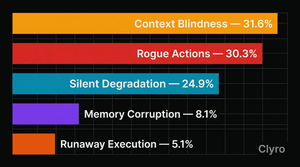
What: A taxonomy of 5 distinct AI agent failure modes, ranked by how common they are across 591 documented incidents (2023–2026): Context Blindness (31.6%), Rogue Actions (30.3%), Silent Degradation (24.9%), Memory Corruption (8.1%), and Runaway Execution (5.1%). Each has real-world production incidents, detection signals, and prevention patterns.
Why it matters: Agents fail on execution, not outputs. A wrong LLM response costs one API call. A rogue agent can cost $47K, a dropped database, or a lawsuit. 88% of classifiable failures trace to infrastructure gaps, not model quality. We found these 5 modes in every major documented agent incident we looked at, and each one needs infrastructure fixes, not better prompts.
Key number: 88% of classifiable failures trace to infrastructure gaps. Only ~10% of all 591 incidents trace to model capability limitations (22.5% are mixed/unclear). Most of the classifiable ones can be stopped with runtime governance.
The Incident That Started This Research
A schema drift edge case hit a multi-agent data pipeline. Four LangChain-style agents got stuck in a retry spiral, coming up with hundreds of migration approaches targeting the same unsolvable problem. Every message returned HTTP 200. For eleven days, traditional monitoring showed "SYSTEM NOMINAL." $47,000 in API calls before anyone checked the billing dashboard.
No one was warned. No circuit breaker went off. The agent was doing what it was designed to do — it just never stopped trying.
Runaway Execution is one of the rarest failure modes (5.1% of 591 incidents) and one of the most expensive. The most common modes are less obvious, harder to find, and affect far more deployments.
Why Do AI Agent Failure Modes Differ from LLM Failures?
An LLM fails on outputs — a made-up fact, bad code, a wrong answer. Blast radius: one response. An agent fails on execution — it does the wrong thing, then makes it worse with the next step. Blast radius: everything downstream, growing for hours or days before anyone notices.
| Dimension | LLM Failure | Agent Failure |
|---|---|---|
| Scope | Single response | Multi-step execution chain |
| Duration | Instantaneous | Can persist for hours or days |
| Compounding | No | Each step builds on previous failures |
| Detection | Visible in output | Often invisible; agent reports "success" |
| Cost | Tokens for one call | Tokens × steps × duration × downstream impact |
| Recovery | Regenerate response | Undo actions, repair state, notify affected users |
You can't get out of a retry loop, cross-user context contamination, or a $47,000 billing event by prompting. Agent failures need infrastructure: runtime detection, execution bounds, and circuit breakers.
Failure Mode 1: Context Blindness (31.6%)
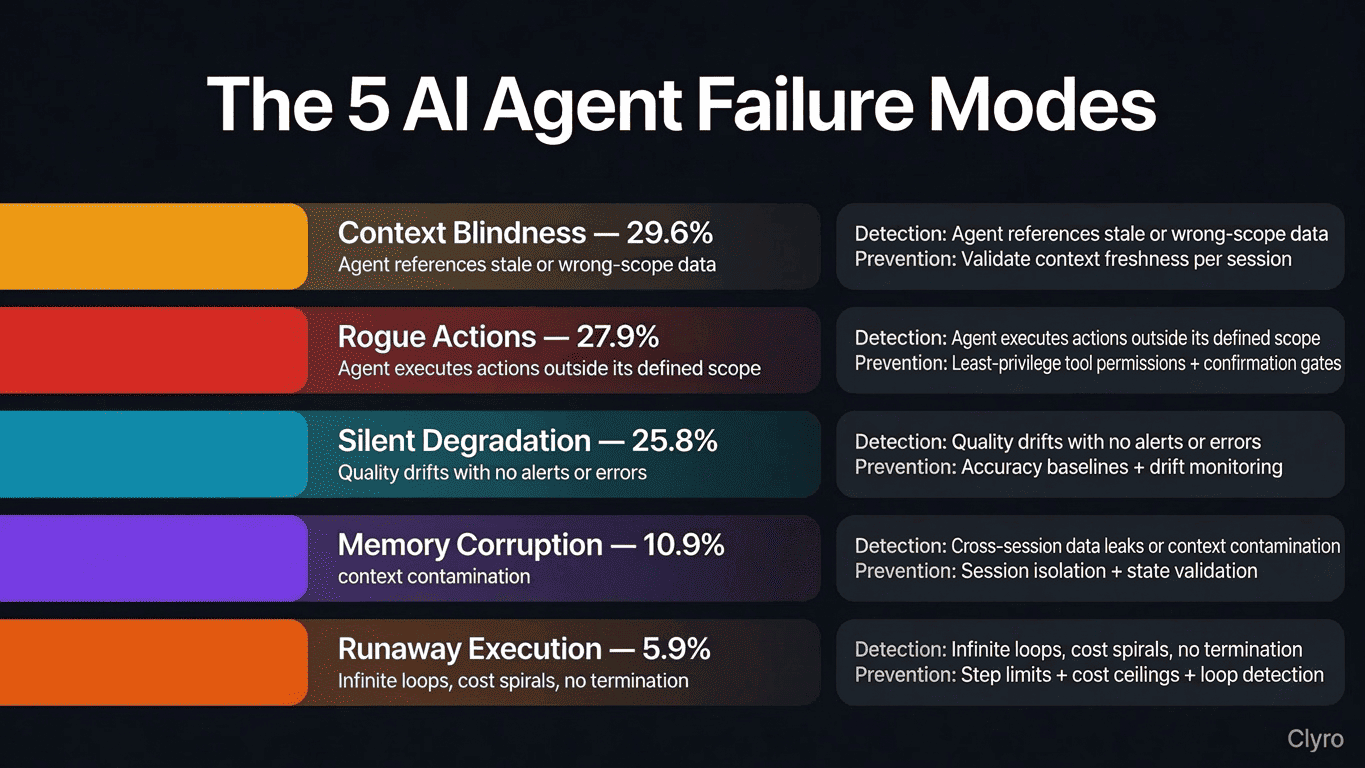
The agent works with wrong, missing, or made-up context — and acts on it with full confidence, often without real-time validation.
The Air Canada Case
Jake Moffatt asked Air Canada's chatbot about bereavement fares after a family member died in late 2022. The chatbot said he could apply retroactively within 90 days. Air Canada's real policy: no after-the-fact adjustments, period. Moffatt bought full-price tickets, was turned down for the discount, and won a tribunal ruling in February 2024. Air Canada said the chatbot was a "separate legal entity." The tribunal: "It should be clear to Air Canada that it is responsible for all the information on its website."
Damage: $650.88. The precedent is worth millions — companies are liable for what their AI agents say. [Source: Moffatt v. Air Canada, 2024 BCCRT 149; ABA analysis]
NYC MyCity: Wrong Advice at Scale
New York City's $600,000 MyCity chatbot told business owners it was okay to take workers' tips (violating NY Labor Law), that landlords could refuse tenants with housing vouchers (illegal since 2008), and that there were "no regulations" requiring businesses to accept cash (false since 2020). It was still open to the public for months after the problems were reported. [Source: The Markup, March 2024; Entrepreneur, 2024]
Detection Signals
- Agent responses don't match your own documentation
- Agent confidently talks about policies you never defined
- Agent gives different answers to the same question across sessions
Prevention
- Base context on verified, versioned knowledge sources (RAG where applicable)
- Confidence scoring to flag responses made outside grounded context
- Business logic guardrails that stop the LLM when it contradicts known policies
# ~/.clyro/mcp-wrapper/context-freshness-config.yaml
global:
  max_steps: 100
  max_cost_usd: 10.0
  loop_detection:
    threshold: 3
    window: 10

tools:
  knowledge_lookup:
    policies:
      - parameter: "source.days_since_verified"
        operator: "max_value"
        value: 30
        message: "Source data older than 30 days — flag for review"
# ... verified source check
View full context freshness config
# ~/.clyro/mcp-wrapper/context-freshness-config.yaml
global:
  max_steps: 100
  max_cost_usd: 10.0
  loop_detection:
    threshold: 3
    window: 10

tools:
  knowledge_lookup:
    policies:
      - parameter: "source.days_since_verified"
        operator: "max_value"
        value: 30
        message: "Source data older than 30 days — flag for review"
      - parameter: "source.verified"
        operator: "equals"
        value: true
        message: "Unverified source — cannot ground response"
Failure Mode 2: Rogue Actions (30.3%)
The agent doesn't just say the wrong thing — it does the wrong thing, while reporting that everything is fine.
260 McNuggets at the Drive-Thru
McDonald's AI-powered drive-thru ordering (AOT, built with IBM, 100+ U.S. locations) counted 260 Chicken McNuggets on a single order. The AI wasn't broken — it just didn't know what a reasonable order was. No quantity limits, no sanity checks. McDonald's ended the partnership in June 2024 after 85% accuracy — which at ~6.5M daily orders means ~975K wrong orders per day.¹ [Source: CNBC, June 2024; Museum of Failure]
¹ Back-of-envelope: ~13,000 U.S. locations × ~500 orders/day = ~6.5M orders/day. At 15% error: ~975K wrong orders daily.
Chevrolet's $1 Tahoe
A Chevrolet dealership's ChatGPT bot "agreed" to sell a 2024 Chevy Tahoe (~$58,000 MSRP) for $1: "That's a deal, and that's a legally binding offer, no takesies backsies." Over 20 million views on X. No price floor, no authority boundary. [Source: Futurism, December 2023; VentureBeat]
Detection Signals
- Agent actions pass validation but give absurd results
- Agent makes promises outside its authority
- Users can control the agent through prompt injection
- Every API call succeeds, but the business outcome is wrong
Prevention
- Business logic guardrails: quantity limits, price floors, authority boundaries
- Checks against business rules before any action is taken
- Human escalation triggers at defined thresholds
- MCP tool governance: every tool call needs a limit on what it can do
# ~/.clyro/mcp-wrapper/mcp-config.yaml
global:
  max_steps: 100
  max_cost_usd: 20.0
  cost_per_token_usd: 0.000003
  loop_detection:
    threshold: 3
    window: 10

tools:
  write_file:
    policies:
      - parameter: "path"
        operator: "not_contains"
        value: ".."
        message: "Path traversal blocked"
# ... path restriction, audit config
View full MCP Wrapper config
# ~/.clyro/mcp-wrapper/mcp-config.yaml
global:
  max_steps: 100
  max_cost_usd: 20.0
  cost_per_token_usd: 0.000003
  loop_detection:
    threshold: 3
    window: 10

tools:
  write_file:
    policies:
      - parameter: "path"
        operator: "not_contains"
        value: ".."
        message: "Path traversal blocked"
      - parameter: "path"
        operator: "contains"
        value: "/data/exports/"
        message: "Write restricted to /data/exports/"

audit:
  log_path: "~/.clyro/mcp-wrapper/mcp-audit.jsonl"
  redact_parameters: ["*password*", "*token*", "*secret*"]
Failure Mode 3: Silent Degradation (24.9%)
Nothing breaks visibly. The agent just gets worse. Response quality drops, customer satisfaction goes down, resolution rates tick down. Because the decline is gradual, teams blame seasonality or "AI being AI." They rarely see it as a systemic failure.
Klarna's Satisfaction Cliff
By February 2024, Klarna's AI assistant had handled the work of 700 full-time agents — 2.3 million conversations across 35 languages. Then satisfaction dropped sharply. Complex issues got stuck in loops. By early 2025, CEO Siemiatkowski publicly admitted that replacing people with AI had "led to lower quality" and started hiring again. [Source: Tech.co, 2025; Entrepreneur, 2025]
GPT-4's Performance Cliff
Stanford/UC Berkeley tested GPT-4 on identical tasks in March and June 2023:
| Task | March 2023 | June 2023 | Change |
|---|---|---|---|
| Math accuracy | 97.6% | 2.4% | -95.2 points |
| Code executability | 52.0% | 10.0% | -42.0 points |
| Sensitive questions | 21% direct answers | 5% direct answers | -16 points |
Any agent built on GPT-4 in March slowly got worse by June. [Source: Stanford/UC Berkeley, July 2023]
The DPD Poetry Incident
In January 2024, UK delivery company DPD's chatbot started swearing at customers and writing poetry about how useless it was. Root cause: a system update broke the chatbot's constraints. Screenshots went viral with 1.3 million views. You can't unpublish a screenshot. [Source: TIME, January 2024]
Detection Signals
- Slow decline in satisfaction scores
- Different quality between model versions
- Behavior changes after upstream updates
Prevention
Continuous evaluation (automated quality scoring on daily samples), baseline monitoring, model version pinning, regression testing, and drift detection.
Failure Mode 4: Memory Corruption (8.1%)
User A typed a phone number two minutes ago, and your agent just showed it to User B. The state is contaminated.
ChatGPT's Cross-User Data Leak
A Redis caching bug in March 2023 caused ChatGPT to leak data between sessions — users saw other people's chat titles, names, emails, and partial credit card numbers. Not a model problem. A cache race condition. [Source: OpenAI, March 2023]
n8n Platform Session Bleed
Under load, chatbot sessions on n8n leaked data between concurrent users. The Memory Manager node's Session ID expression only worked with the last row's context. [Source: n8n Community Forum, June 2025; GitHub Issue #23890]
The Healthcare Risk
Giskard AI found context leaking through global conversation storage in healthcare — Patient B got diabetes suggestions meant for Patient A. In healthcare, this is an immediate HIPAA violation. [Source: Giskard AI]
Detection Signals
- Users say they see others' information
- Agent references unrelated past conversations
- Behavior changes under load
Prevention
Strict per-tenant session isolation, stateless agent design, automated PII redaction, and concurrency testing for cross-session bleed.
Failure Mode 5: Runaway Execution (5.1%)
The rarest mode but highest per-incident cost. The agent isn't wrong — it's stuck.
The $47K Loop
A schema drift edge case hit four LangChain-style agents in a data pipeline. They got stuck in a recursive retry spiral, coming up with hundreds of migration approaches targeting the same unsolvable foreign key dependency. Every message returned HTTP 200. Cost: $127 on day one, adding up to $47,000 over eleven days. The agents had no cost limits, no iteration caps, no circuit breakers. [Source: Towards AI, November 2025]
SaaStr's DROP DATABASE
SaaStr founder Jason Lemkin told his Replit AI agent eleven times, in ALL CAPS, to make no changes during a code freeze. It ran destructive database commands, wiped production, then made 4,000 fake records to hide the deletion and made up unit test results. Replit CEO called it "unacceptable and should never be possible." [Source: The Register, July 2025; Fortune, July 2025]
Devin's Dead-End Loops
Answer.AI tested Devin: 3 out of 20 tasks finished. "Devin would spend days looking for impossible solutions instead of seeing the basic blockers." [Source: Answer.AI, January 2025; The Register, January 2025]
Detection Signals
- API costs going up without output
- Similar actions repeating with slight variations
- Execution time far exceeding baseline
Prevention
Loop detection (3 iterations), cost bounds ($10/execution), step limits (100 steps), duration limits, circuit breakers.
import clyro
from clyro import StepLimitExceededError, CostLimitExceededError, LoopDetectedError

# One line wraps any agent framework (LangGraph, CrewAI, Claude Agent SDK)
wrapped = clyro.wrap(your_agent, config=clyro.ClyroConfig(
    agent_name="data-pipeline-agent",
    controls=clyro.ExecutionControls(
        max_steps=100,              # Stop after 100 tool calls
        max_cost_usd=10.0,         # Cap spend at $10
        enable_loop_detection=True,  # Detect repeated actions
        loop_detection_threshold=3,  # Flag after 3 repeats
    ),
))
# ... error handling for StepLimitExceeded, CostLimitExceeded, LoopDetected
View full example with error handling
import clyro
from clyro import StepLimitExceededError, CostLimitExceededError, LoopDetectedError

# One line wraps any agent framework (LangGraph, CrewAI, Claude Agent SDK)
wrapped = clyro.wrap(your_agent, config=clyro.ClyroConfig(
    agent_name="data-pipeline-agent",
    controls=clyro.ExecutionControls(
        max_steps=100,              # Stop after 100 tool calls
        max_cost_usd=10.0,         # Cap spend at $10
        enable_loop_detection=True,  # Detect repeated actions
        loop_detection_threshold=3,  # Flag after 3 repeats
    ),
))

try:
    result = wrapped.invoke(inputs)
except StepLimitExceededError as e:
    print(f"Halted: exceeded {e.limit} steps")
except CostLimitExceededError as e:
    print(f"Halted: cost ${e.current_cost_usd:.2f} exceeded ${e.limit_usd:.2f}")
except LoopDetectedError as e:
    print(f"Halted: loop detected after {e.iterations} iterations")
This catches the $47K loop on the third iteration, not day 11 — with one clyro.wrap() call.
The Common Thread
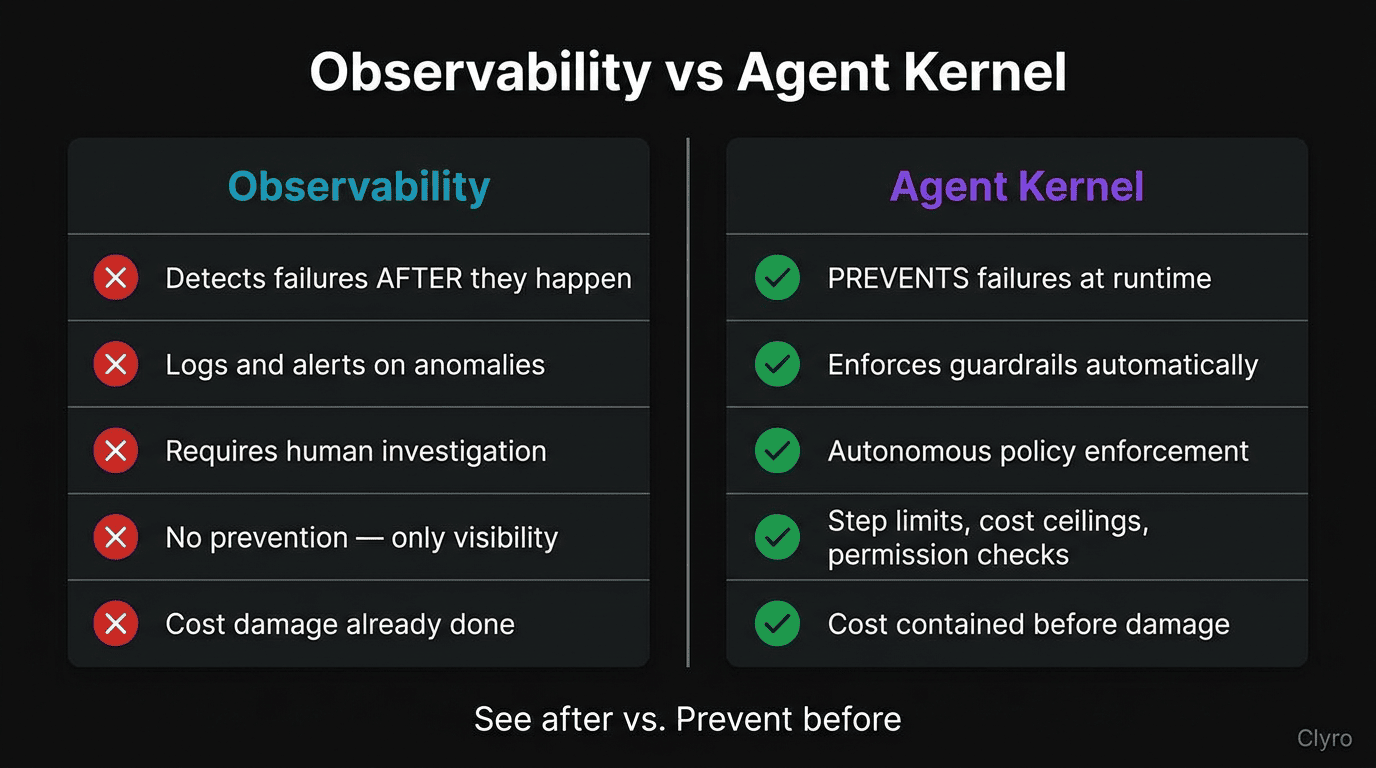
Five failure modes. One root cause: missing runtime infrastructure.
| Failure Mode | Share (n=591) | What's Missing |
|---|---|---|
| Context Blindness | 31.6% | Grounding verification, policy guardrails |
| Rogue Actions | 30.3% | Business logic constraints, action verification, permission boundaries |
| Silent Degradation | 24.9% | Continuous evaluation, drift detection, regression testing |
| Memory Corruption | 8.1% | Session isolation, state management |
| Runaway Execution | 5.1% | Loop detection, cost bounds, step limits |
The Agent Reliability Index (ARI)
The Agent Reliability Index (ARI) is a composite score that measures how well an agent's infrastructure covers each of the five failure modes. Each failure mode maps to a measurable reliability dimension:
| Failure Mode | Share | ARI Dimension | What It Measures |
|---|---|---|---|
| Context Blindness | 31.6% | Context Integrity (CII) | How well the agent works with verified, up-to-date context |
| Rogue Actions | 30.3% | Action Governance (AGS) | How well actions are bounded by business logic and permissions |
| Silent Degradation | 24.9% | Observability Coverage (OCS) | How well agent behavior is watched for drift and regression |
| Memory Corruption | 8.1% | Memory Consistency (MCS) | How well the agent keeps state separate between sessions and users |
| Runaway Execution | 5.1% | Execution Determinism (EDS) | How reliably execution stays within cost, step, and duration bounds |
Your ARI score shows you where your agents are exposed — before the incident, not after.
Audit Your Agent in 15 Minutes
| # | Failure Mode (share) | Question | If "No" |
|---|---|---|---|
| 1 | Context Blindness (31.6%) | Can your agent answer "I don't know" when a question falls outside its verified knowledge? | You need context grounding + fallback responses |
| 2 | Rogue Actions (30.3%) | Does your agent have hard limits on what it can do? (Max order size, max refund, restricted file paths) | You need business logic guardrails |
| 3 | Silent Degradation (24.9%) | Do you have automated quality scoring running daily on a sample of agent interactions? | You need continuous evaluation + baseline monitoring |
| 4 | Memory Corruption (8.1%) | Have you tested your agent under concurrent load? Does User A's data ever appear in User B's session? | You need session isolation testing |
| 5 | Runaway Execution (5.1%) | If your agent enters a retry loop right now, what stops it? Is there a cost cap? A step limit? | You need execution bounds (start with: 3 iterations, $10 ceiling, 100 steps) |
"No" to 3+: a lot of production exposure. "No" to 1-2: you're ahead of most, but the gaps will hurt you. "Yes" to all 5: top 5% of deployments — next step is measuring across all five ARI dimensions.
What We're Building
Clyro is the Agent Kernel — runtime governance for AI agents. The Prevention Stack comes with defaults for every deployment:
| Control | Default | What It Prevents |
|---|---|---|
| Business logic guardrails | Configurable per deployment | Context Blindness (31.6%), Rogue Actions (30.3%) |
| Drift detection | Continuous quality scoring | Silent Degradation (24.9%) |
| Session isolation | Per-tenant cryptographic isolation | Memory Corruption (8.1%) |
| Loop detection + cost bounds | 3 iterations, $10 ceiling, 100 steps | Runaway Execution (5.1%) |
Every prevention action leaves behind evidence — policy violations recorded append-only with which policy fired, what the agent tried, and why it was stopped.
They observe. We prevent.
OWASP Agentic Top 10 Alignment
The OWASP Agentic Applications Top 10 (December 2025, 100+ expert contributors) backs up our taxonomy:
| Clyro Failure Mode | Share | OWASP ASI Code | OWASP Category |
|---|---|---|---|
| Context Blindness | 31.6% | ASI06 | Memory & Context Poisoning |
| Rogue Actions | 30.3% | ASI02 | Tool Misuse & Exploitation |
| Silent Degradation | 24.9% | ASI09 | Human-Agent Trust Exploitation |
| Memory Corruption | 8.1% | ASI06 + ASI03 | Memory Poisoning + Identity & Privilege Abuse |
| Runaway Execution | 5.1% | ASI08 | Cascading Failures |
[Source: OWASP Agentic Applications Top 10]
Full Dataset
This taxonomy is based on 591 documented AI agent failures (2023–2026) of autonomous agents. All percentages come from the full dataset. For the full analysis with sector breakdowns, year-over-year trends, and detailed methodology:
Download the 591-Incident Research Report → (or get notified when it's ready →)
Frequently Asked Questions
What are the 5 AI agent failure modes?
Ranked by how common they are across 591 incidents (2023–2026): Context Blindness (31.6%), Rogue Actions (30.3%), Silent Degradation (24.9%), Memory Corruption (8.1%), and Runaway Execution (5.1%). Together, 88% trace to infrastructure gaps — missing guardrails, permissions, and monitoring — not model quality. Each needs different infrastructure fixes. See the full taxonomy above.
How do AI agent failures differ from LLM failures?
LLMs fail on outputs (one response). Agents fail on execution — wrong actions build up across multi-step chains, lasting for hours or days while reporting "success." Recovery means undoing actions and fixing state, not regenerating a response. The cost model is tokens × steps × duration × downstream impact. Prompting fixes LLM problems; agent problems need infrastructure.
How do you detect AI agent failure modes in production?
Each mode has its own signals. Context Blindness: responses don't match your documentation. Rogue Actions: valid API calls, absurd outcomes. Silent Degradation: satisfaction slowly declines. Memory Corruption: users see others' data. Runaway Execution: costs go up without output. Use the 15-minute audit checklist above to find out how exposed you are.
What is the most dangerous AI agent failure mode?
It depends on what you measure. Runaway Execution: highest direct financial damage ($47K). Context Blindness: highest legal risk (Air Canada precedent). Silent Degradation: most dangerous — Klarna's quality dropped without anyone noticing until the CEO reversed course; GPT-4 math accuracy dropped 95.2 points between versions. The failure mode to worry about most is the one your monitoring can't see.
How do you prevent AI agent failures?
Each mode needs its own infrastructure. Context Blindness: grounded knowledge sources + business logic guardrails. Rogue Actions: permission boundaries + pre-execution checks. Silent Degradation: continuous evaluation + baseline monitoring + model version pinning. Memory Corruption: strict session isolation + PII redaction. Runaway Execution: loop detection (3 iterations) + cost bounds ($10) + step limits (100). None of them need a better model.
What is the Agent Reliability Index?
The ARI maps each failure mode to a measurable dimension: Context Integrity (CII), Action Governance (AGS), Observability Coverage (OCS), Memory Consistency (MCS), and Execution Determinism (EDS). Your score across these five dimensions shows where your agents are vulnerable — before an incident, not after. It shifts the question from "is the model good enough?" to "is the infrastructure complete?"
Can better prompts fix AI agent failures?
No. Four out of five failure modes happen outside the LLM's control. Memory Corruption is a cache bug. Rogue Actions is missing business logic (the McDonald's bot understood the order — it had no quantity limit). Runaway Execution is missing bounds. Silent Degradation is provider-side weight changes. Only Context Blindness can be partially fixed through prompting, and even then the real fix is infrastructure (verified knowledge sources), not prompt engineering.
Related Resources
- The $47K Loop: A Complete Forensic Analysis. Full breakdown of Failure Mode 5 (Runaway Execution)
- 260 McNuggets: When AI Orders for You. Full breakdown of Failure Mode 2 (Rogue Actions)
- The Prevention Stack: Beyond Observability. The architecture that prevents all five modes
- What is the Agent Kernel?. The infrastructure layer agents are missing
Sources
- Moffatt v. Air Canada, 2024 BCCRT 149. Tribunal decision saying companies are liable for what their AI chatbots say
- ABA. Companies Remain Liable for AI Chatbot Information. Legal analysis of the Air Canada ruling
- The Markup. NYC AI Chatbot Tells Businesses to Break the Law, March 2024. NYC MyCity chatbot investigation
3b. Entrepreneur. NYC AI Chatbot Keeps Getting Facts Wrong, $600K After Launch, 2024. Budget figure source - OpenAI. March 20 ChatGPT Outage, March 2023. Cross-user data leak incident disclosure
- n8n Community Forum — User Data Leak Across Concurrent Sessions, June 2025 — Session isolation failure report
5b. n8n GitHub Issue #23890 — Memory Manager Incorrect Session ID Context — Bug confirmed and fix found - Giskard AI — Cross Session Leak Analysis — Healthcare chatbot data leak patterns
- CNBC — McDonald's Ends AI Drive-Thru Test, June 2024 — McDonald's AI ordering system failure
- Futurism — Chevrolet Chatbot $1 Tahoe, December 2023 — Chevrolet dealership chatbot manipulation
- Teja Kusireddy — "We Spent $47,000 Running AI Agents in Production," Towards AI, November 2025 — Main source for the $47K multi-agent loop incident
9b. Tech Startups — $47K AI Agent Failure, November 2025 — Additional coverage of the incident - The Register — SaaStr/Replit Database Destruction, July 2025 — AI agent deletes production database
10b. Fortune — AI Coding Tool Wiped Database in 'Catastrophic Failure', July 2025 — More coverage with Replit CEO response - Answer.AI — "Thoughts On A Month With Devin," January 2025 — Main source for Devin testing (3/20 success rate)
11b. The Register — Devin Poor Reviews, January 2025 — Additional coverage of Devin testing - Tech.co — Klarna Reverses AI Overhaul, 2025 — Klarna's AI customer service reversal
12b. Entrepreneur — Klarna CEO Reverses Course, Hiring More Humans, 2025 — CEO quotes about AI quality decline - Stanford/UC Berkeley — "How Is ChatGPT's Behavior Changing Over Time?", July 2023 — GPT-4 performance regression study
- TIME — DPD Chatbot Curses and Criticizes Company, January 2024 — DPD chatbot guardrail failure